
HISTORY & MEMORY · NOVEMBER 10, 2026

No Mail, Low Morale: The 6888th Kept Service Members Connected

Three shifts a day, seven days a week: Black women turned undelivered mail into a lifeline between service members and home.

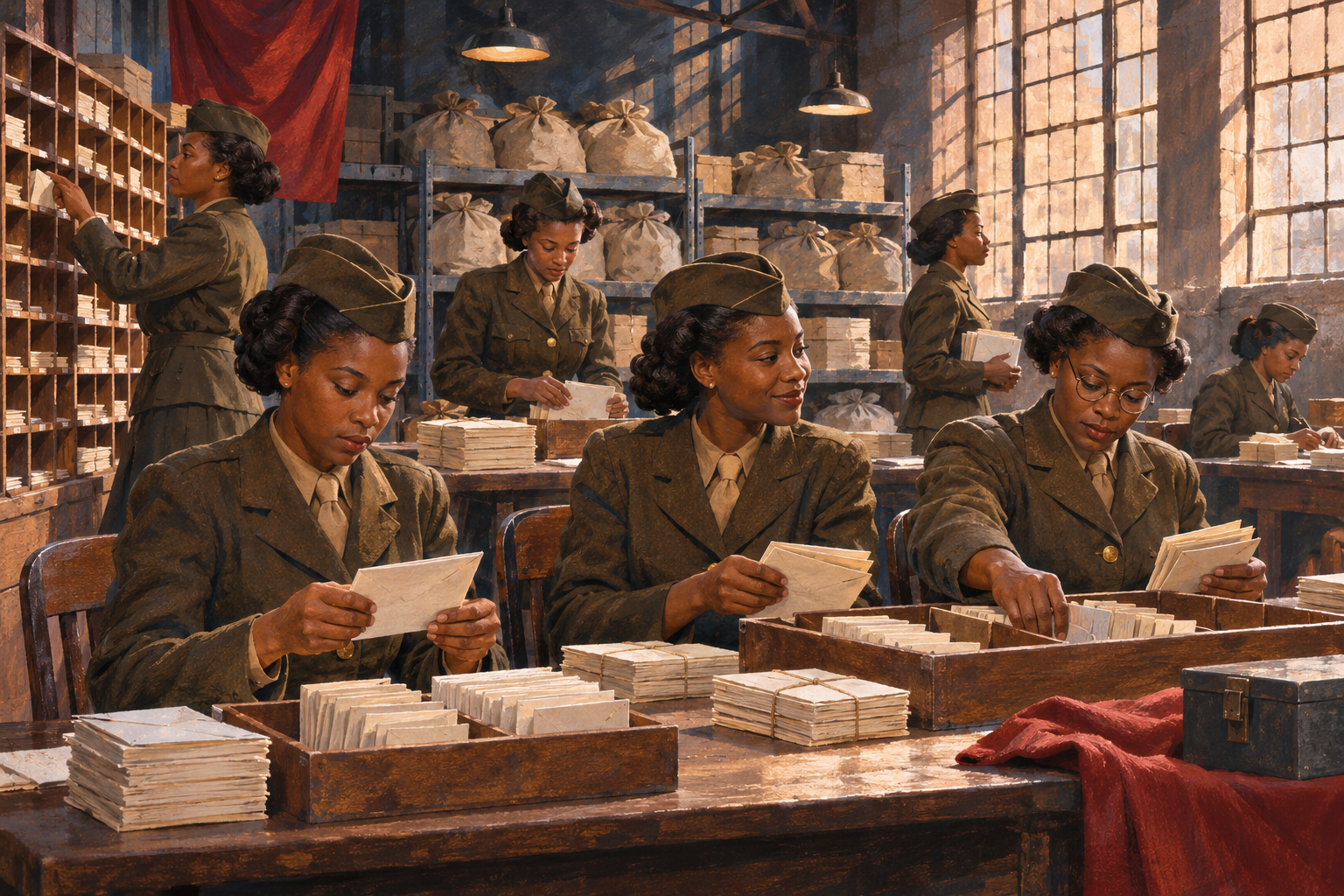
Editorial illustration of the 6888th Central Postal Directory Battalion sorting military mail.
Generated editorial illustration for VHVATC’s history series. It is not an archival photograph or historical artifact.

Military history often counts combat power in weapons, sorties, and territory. The 6888th Central Postal Directory Battalion shows another form of wartime power: restoring the connection between a service member and the people waiting at home.

The problem was not only combat

In early 1945, the 6888th became the only Women’s Army Corps unit made up of women of color to serve overseas during World War II. Led by Major, later Lieutenant Colonel, Charity Adams, the battalion was responsible for redirecting mail to more than seven million U.S. personnel in the European Theater of Operations.

The mission was logistical, but it was also human. Mail carried news, reassurance, birthdays, grief, and the feeling that a person far from home had not disappeared from the lives of the people who loved them.

Three shifts, seven days

The National Archives records that the unit was first stationed in Birmingham, England, and later moved to Rouen, France. The women worked three eight-hour shifts seven days a week to clear a backlog of undelivered mail and parcels.

The Archives account says the battalion processed about 65,000 pieces of mail per shift. That number is not a decoration; it explains the scale of the problem and the disciplined system the battalion built to solve it.

What the archives also tell us

The battalion was officially organized on March 4, 1945, according to Organizational Order No. 147 of Headquarters, Communications Zone, European Theater of Operations. The same National Archives feature cautions that records about the unit are limited.

That limitation is part of the work of remembrance. A story can be compelling without pretending the archive is complete. The task is to name what the record supports, identify what remains missing, and keep looking.

THEN · NOW · JOIN

Honor the record. Make the next step clearer.

This history stands on its own. The present-day work also deserves clear evidence, plain language, and a defined invitation.

THENThe historical record

The 6888th made connection part of military readiness, while the surviving record still requires careful preservation and research.

NOWVHVATC Today

VHVATC’s public pages describe community support and navigation for Veterans and their families. Current service language is presented separately from the World War II history.

JOINA reader’s choice

Read the Archives source, help keep the 6888th visible in public history, and connect with VHVATC about current ways to serve, partner, volunteer, or seek support.

SEE THE WORK BEFORE YOU FUND THE MISSION

Evidence should come before the ask.

NEED

The wartime need was to reconnect millions of service members with delayed mail and the people at home.

WHAT THE RECORD SHOWS

The National Archives documents the battalion’s overseas service, leadership, locations, schedule, and mail-processing workload.

WHERE & WHEN

The unit was organized in March 1945 and served in Birmingham, England, and Rouen, France.

EVIDENCE AVAILABLE

The official National Archives feature and its warning about limited records are linked directly.

WHAT SUPPORT COULD MAKE POSSIBLE NEXT

Clear current evidence can help today’s supporters see what a specific contribution, partnership, or volunteer role is meant to make possible.