
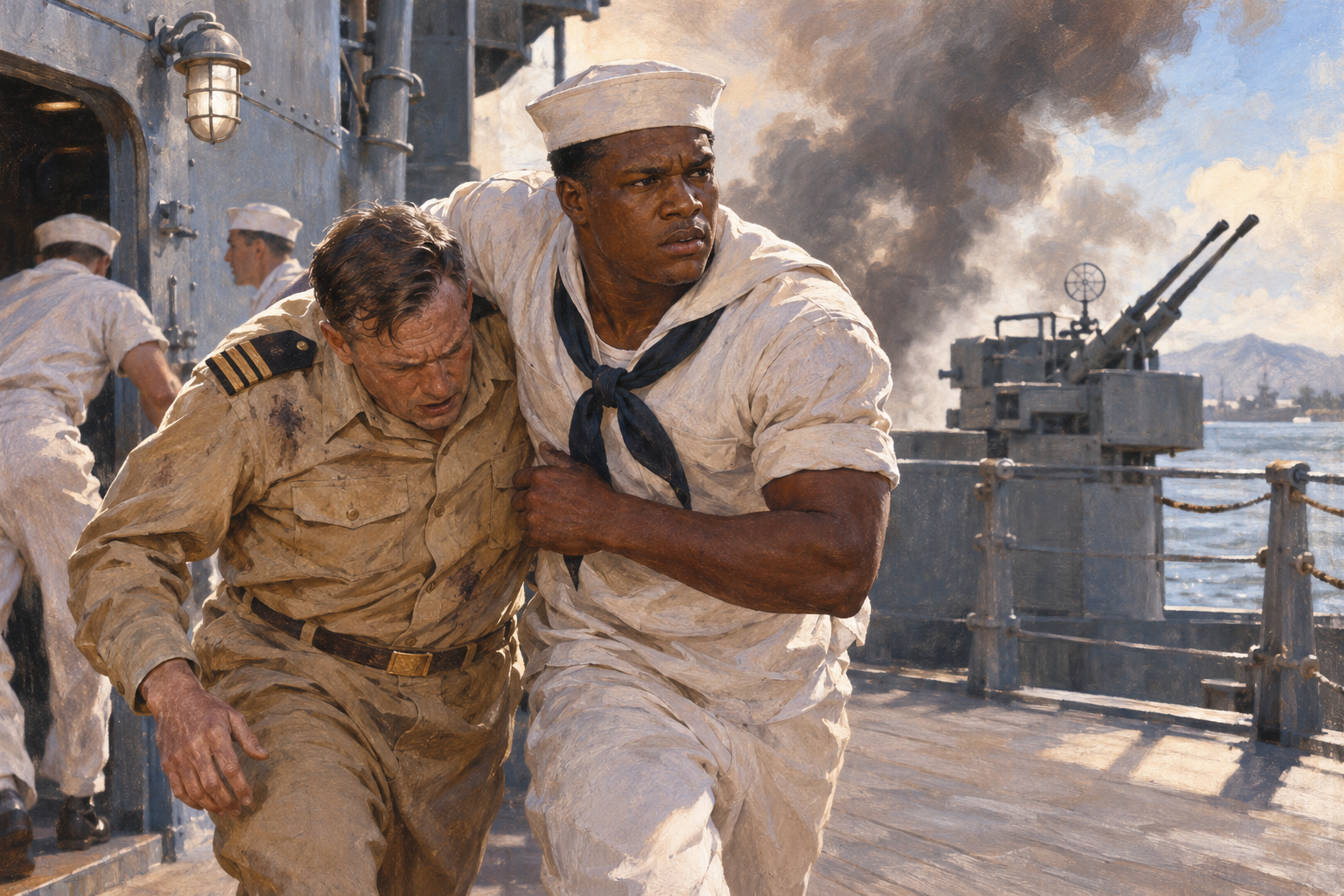
Dorie Miller’s story begins with an institution that limited Black sailors’ roles and continues with a moment when courage made those limits impossible to ignore.
At Pearl Harbor, the job description shifted
Doris Miller was born on October 12, 1919, in Waco, Texas, and enlisted in the Navy in September 1939 as a mess attendant third class. On December 7, 1941, he was serving aboard USS West Virginia during the Japanese attack on Pearl Harbor.
The Navy’s history account records that Miller took over a machine gun during the attack. The moment matters because it placed a Black sailor whose formal rating was not a gunner inside one of the most consequential emergencies in American military history.
Recognition in public
Miller received the Navy Cross for his actions at Pearl Harbor. Admiral Chester W. Nimitz presented the award on May 27, 1942, on the flight deck of USS Enterprise at Pearl Harbor.
The award did not erase the racial structure that had shaped Miller’s assignment. It did make a public record of what his service demanded from him when the ship came under attack.
The war continued, then ended in loss
Miller served aboard USS Indianapolis from December 1941 to May 1943. He was then assigned to the escort carrier Liscome Bay and was promoted to cook third class in June 1943.
He was lost at sea on November 24, 1943, when Liscome Bay was torpedoed by a Japanese submarine. His story therefore includes both the recognition of one day at Pearl Harbor and the full human cost of a war that continued long after the medal ceremony.